Understanding Ni-Hard Iron Castings for Industrial Wear Applications

Ni-Hard is a family of nickel-chromium white cast irons engineered for severe abrasion environments where wear resistance is critical and moderate impact loading is still present.
Under ASTM A532 Class I, the family is divided into Type A, B, C, and D, more commonly known as Ni-Hard 1, 2, 3, and 4. The performance of each grade depends on factors like carbide structure, retained austenite levels, and heat treatment. ASTM A532 recognizes matrices containing carbides, martensite, bainite, and austenite, and allows these alloys to be supplied in several conditions including as-cast, stress-relieved, hardened, or softened for machining.
TFA note: Ni-Hard is not just one material. It is a group of abrasion-resistant iron alloys with different performance characteristics depending on composition and heat treatment. Choosing the right grade depends on the wear environment, impact levels, and how the casting will be processed after pouring.
For OEMs, the differences between the grades are fairly straightforward. Ni-Hard 1 is typically the most cost-effective option for severe sliding abrasion with lower impact stress because it contains a higher carbide volume. Ni-Hard 2 sacrifices some wear resistance in exchange for improved toughness. Type C is commonly used for grinding balls and features a martensitic structure. Ni-Hard 4 uses higher chromium and silicon levels to form rod-like M7C3 carbides along with a tougher, heat-treatable matrix, making it a strong choice for heavy sections, slurry pumps, and applications involving both abrasion and impact.
TFA note: Each Ni-Hard grade is built for a slightly different job. Some prioritize maximum wear resistance, while others balance wear with improved toughness and impact performance. Matching the grade to the real operating conditions is critical for long-term part life.
One of the most common specification issues is simply calling out “Ni-Hard” without identifying the exact ASTM class, type, and heat-treatment condition. Since commercial naming conventions for grades like “Ni-Hard 3” can vary between suppliers and standards, incomplete specifications can create unnecessary procurement and performance risks.
TFA note: Saying only “Ni-Hard” on a print or RFQ is usually not enough. Without the exact ASTM designation and condition, suppliers may quote or produce different materials than intended, which can lead to performance issues or sourcing confusion.
Ni-Hard alloys also require careful process control. While they provide exceptional hardness and wear resistance, they are inherently brittle and highly sensitive to chemistry, cooling rates, and heat treatment. Section thickness affects the ideal nickel-to-chromium balance, and excessive retained austenite can reduce hardness and increase the likelihood of spalling under repeated impact. Poor chemistry control can also introduce graphite or pearlite, both of which reduce wear performance. Because of this brittleness, weld repair is generally avoided whenever possible. In practice, successful Ni-Hard castings depend just as much on foundry process control and heat treatment as they do on the base chemistry itself.
TFA note: Ni-Hard performance depends heavily on how the casting is produced, not just the alloy chemistry itself. Melt practice, cooling rate, and heat treatment all directly affect durability and wear life. Even a properly specified alloy can fail if process control is inconsistent.
Ni-Hard White Iron Castings Grades and Chemistry
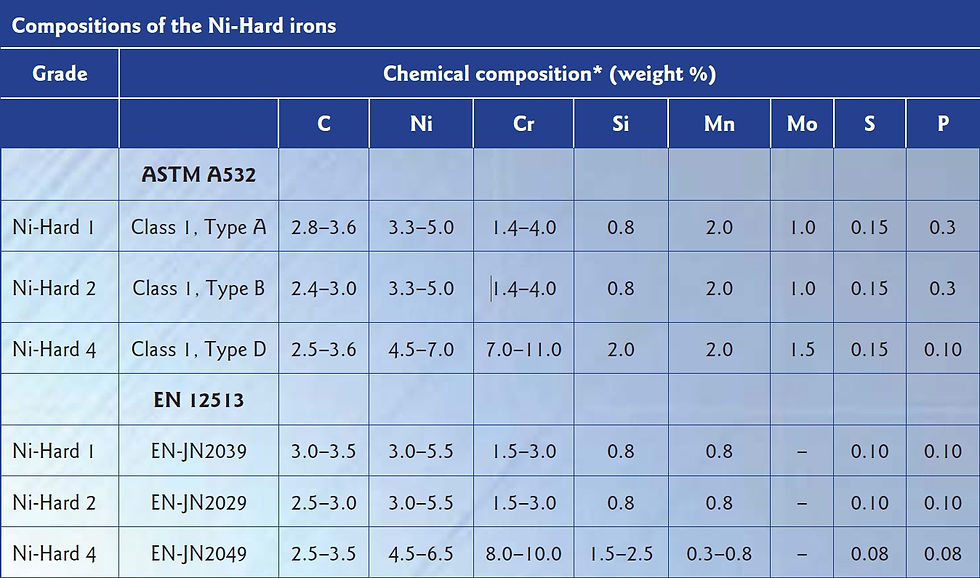
The clearest official framework for Ni-Hard procurement is ASTM A532 Class I. ASTM Type A is the Ni-Cr high-carbon grade, Type B is the lower-carbon variant, Type C is the grinding-ball grade, and Type D is the higher-chromium “Ni-HiCr” grade.
Common name | Official designation | Typical chemistry, wt% | Typical hardness | Typical uses |
|---|---|---|---|---|
Ni-Hard 1 | ASTM A532 Class I Type A | C 2.8–3.6, Ni 3.3–5.0, Cr 1.4–4.0, Si ≤0.8, Mn ≤2.0, Mo ≤1.0 | As-cast often ~500 HB; published casting range about 550–690 HB | Crusher and chute liners, augers, elbows, volutes/impellers, cyclones, steel-mill rollers |
Ni-Hard 2 | ASTM A532 Class I Type B | C 2.4–3.0, Ni 3.3–5.0, Cr 1.4–4.0, Si ≤0.8, Mn ≤2.0, Mo ≤1.0 | Foundry guideline about 54–60 HRC at 30 mm; published sand-cast range about 530–630 HB | Slurry-pump parts and mineral-concentration equipment where higher toughness than Type A is useful |
Ni-Hard 3 | ASTM A532 Class I Type C | ASTM Type C is a Ni-Cr grinding-ball grade; public summaries show C about 2.5–3.7, Ni up to about 4.0, Cr about 1.0–2.5, Si ≤0.8, Mn ≤2.0 | ASTM condition-dependent hardness roughly 500 HB as-cast and higher after hardening; largely martensitic as-cast | Grinding balls, ball-mill components, liners, crusher concaves, pulverizing pegs |
Ni-Hard 4 | ASTM A532 Class I Type D | C 2.5–3.6, Ni 4.5–7.0, Cr 7.0–11.0, Si ≤2.0, Mn ≤2.0, Mo ≤1.5 | Foundry guideline about 56–63 HRC at 30 mm; published range about 550–700 HB; Wilfley reports average 600–655 HBN |
Table sources and notes: ASTM A532 provides the official Class I chemistry and condition-dependent hardness requirements; Penticton Foundry provides published Ni-Hard 1 hardness and application data; Mekava provides commercial target chemistries and 30 mm hardness guidelines for Ni-Hard 2 and 4; Canadian Wear provides the Type C/Type D commercial mapping and applications; Wilfley publishes a NiHard 4 average hardness range for pump service. One recurring nomenclature issue is that some non-ASTM commercial literature uses “Ni-Hard 3” for a lower-carbon composition around 1.0–1.6%C, 4.0–4.75%Ni, and 1.4–1.8%Cr, while ASTM Type C “Ni-Hard 3” is a different, grinding-ball-oriented grade. Source.
Microstructure and Properties
A useful way to think about Ni-Hard is that it is not just one material. It is a family of wear-resistant irons built around different combinations of hard carbides and supporting metal structures, called matrices. Those combinations determine how the material handles abrasion, impact, and cracking.
TFA note: The carbide structure provides the wear resistance, while the surrounding matrix determines how much toughness and impact resistance the casting has. Different Ni-Hard grades balance those properties differently depending on the application.
Ni-Hard 1 and Ni-Hard 2 are very similar in chemistry and are both built around a dense network of hard M3C carbides. Ni-Hard 1 contains more carbide volume, typically around 40 to 44%, which makes it harder and more resistant to sliding abrasion. Ni-Hard 2 contains slightly less carbide, around 35 to 40%, which improves toughness and reduces brittleness somewhat. Depending on casting thickness, cooling rate, and heat treatment, the matrix can contain different amounts of martensite, retained austenite, bainite, and secondary carbides.
TFA note: Ni-Hard 1 is usually chosen when maximum abrasion resistance is the priority. Ni-Hard 2 gives up a small amount of wear resistance in exchange for better toughness and crack resistance under stress or impact.
Ni-Hard 4 is significantly different from Ni-Hard 1 and 2. It uses higher chromium, nickel, and silicon levels to create rod-shaped M7C3 carbides instead of the plate-like carbides found in earlier grades. It also contains a lower overall carbide volume, usually around 20 to 28%. Because of this structure, Ni-Hard 4 is generally better at handling impact and fracture-prone wear environments like slurry pumps and heavy industrial sections. In the as-cast state, it often contains high retained austenite levels, but after heat treatment the matrix becomes mostly martensitic with additional secondary carbides for improved hardness and wear resistance.
TFA note: Ni-Hard 4 is designed to survive tougher operating conditions where both abrasion and impact are present. It is usually a better option for heavier-duty applications where cracking resistance matters just as much as wear life.
Type C fits somewhat between these groups from an application standpoint. It is commonly used for grinding balls and repeated-impact environments. Its microstructure is primarily martensitic with eutectic carbides, and it is typically supplied with only low-temperature tempering rather than aggressive hardening treatments.
TFA note: Type C is less about achieving maximum hardness and more about surviving repeated impact in grinding and milling environments. For OEMs, the key question is usually whether it matches the operating conditions of the mill or grinding system rather than how much additional hardness can be added.
Ni-Hard Wear, Failure, and Heat Treatment
Ni-Hard performs best in applications involving sliding abrasion, slurry wear, and erosion where hard carbides protect the surface from wear while the surrounding matrix supports those carbides and keeps them from breaking loose. Higher carbon levels and a harder martensitic matrix generally improve abrasion resistance, as long as unwanted graphite does not form. Retained austenite can also help in some high-stress wear conditions because it can work harden during service. However, too much retained austenite can become a problem under repeated impact because it may transform during operation, create internal stresses, and eventually lead to spalling or cracking.
TFA note: Ni-Hard works by combining extremely hard carbides with a supportive matrix underneath. More hardness usually improves wear resistance, but too much retained austenite can reduce long-term durability in impact-heavy applications.
Recent wear studies on Ni-Hard 4 support what foundries have observed for years in production environments. Research shows that the austenitic matrix and eutectic carbides work together to resist abrasion and erosion, but the primary wear mechanisms are still abrasive grooves, micro-cracking, delamination, and surface plowing. When carbides are not properly supported by the matrix, they can break loose and accelerate wear. In real-world applications, Ni-Hard failures are commonly caused by softened matrices, carbide pullout, surface cracking, spalling, brittle fracture, or stress concentrations tied to casting defects.
TFA note: Most Ni-Hard failures happen when the matrix cannot properly support the carbides. Once cracking or carbide pullout begins, wear accelerates quickly and can eventually lead to brittle failure.
Heat treatment is one of the main ways foundries control the balance between wear resistance and toughness. For Ni-Hard 1 and 2, lower-temperature tempering around 225–275 °C is commonly used to relieve stress and improve fatigue resistance without sacrificing too much hardness. Some foundries use multi-stage tempering cycles to further improve repeated-impact performance. When maximum abrasion resistance is required, more aggressive hardening cycles at higher temperatures may be used instead. Ni-Hard 4 requires a different approach, typically involving high-temperature destabilization heat treatment followed by controlled cooling to form secondary carbides and convert retained austenite into martensite. Cryogenic treatment is sometimes used to further reduce retained austenite, but it is considered more specialized than standard production practice.
TFA note: Heat treatment changes how Ni-Hard behaves in service. Foundries use it to fine-tune the balance between hardness, wear resistance, and impact durability depending on the operating environment and application requirements.
The relationship between processing and performance is critical with Ni-Hard alloys. Chemistry alone does not determine how the material will perform. Cooling rate, section thickness, carbide formation, retained austenite levels, and heat treatment all interact to influence wear life, toughness, and cracking resistance.
TFA note: Ni-Hard performance depends on the entire manufacturing process, not just the alloy chemistry. Foundry process control plays a major role in whether the final casting succeeds or fails in service.
Foundry Processing, Machining, and OEM Design for Ni-Hard Castings

Successful Ni-Hard castings start with tight control over melting and cooling practices. While foundries can use molding systems similar to those used for gray iron, ductile iron, or steel castings, the gating and feeding systems need to behave more like steel because Ni-Hard does not contain graphite and shrinks more during solidification. Pouring temperatures are typically kept between 1350–1400 °C to maintain a fine carbide structure and avoid excessive grain growth. Cupola melting is generally avoided, especially for Ni-Hard 4, because it can introduce unwanted carbon pickup. Charge materials and returns also need close control since dirty or wet scrap can introduce gases, oxygen, and cracking risks.
TFA Note: Ni-Hard is very process-sensitive. Melt cleanliness, pouring temperature, and cooling rate all directly affect wear resistance and structural integrity. Small process changes can create major differences in final casting performance.
Section thickness is also critical when producing Ni-Hard castings. As wall thickness increases, foundries often need to increase nickel and chromium levels to maintain the desired microstructure throughout the casting. This is why the same nominal alloy grade can perform differently in thin sections versus heavy sections if chemistry adjustments are not made. For Ni-Hard 1 and 2, chill casting or chilling specific wear surfaces can improve carbide refinement and wear resistance, although uneven chilling can also create distortion. Ni-Hard 4 behaves differently and generally does not benefit from chilling.
TFA Note: Wall thickness should be treated as part of the alloy design itself. Large section changes affect cooling rates, carbide formation, and final hardness, which is why foundry involvement early in the design stage matters.
Inoculation practices also vary depending on the Ni-Hard grade. For Ni-Hard 1 and 2, small magnesium additions or FeSi75 inoculation can improve fracture resistance and structure refinement. Ni-Hard 4 usually gains little benefit from these treatments. Foundry literature also notes that late-stage inoculation cannot fix carbide structures that were already damaged earlier by overheating the melt. Silicon levels must also stay carefully controlled. Too much silicon in Ni-Hard 1 and 2 can promote graphite formation and reduce wear resistance, while Ni-Hard 4 intentionally uses higher silicon levels to help create its rod-like carbide structure.
TFA Note: Chemistry balance is extremely important with Ni-Hard alloys. Elements like silicon and magnesium can improve or damage wear performance depending on the grade and processing conditions.
Machining Ni-Hard is difficult and expensive because of its hardness. Grinding is usually the preferred finishing method, especially wet grinding, which helps reduce heat-related cracking. When machining is required, rigid setups and advanced tooling like CBN inserts are often necessary because traditional carbide tools wear quickly. Many OEMs reduce machining costs by designing features like holes, threads, or attachment points directly into the casting or by using cast-in steel inserts instead of machining hardened white iron afterward.
TFA Note: The best Ni-Hard designs minimize machining whenever possible. OEMs can often lower total production costs by leaving wear surfaces as-cast or ground instead of fully machining every surface.
For OEMs, several design practices consistently improve Ni-Hard casting success. First, specifications should always include the exact ASTM grade and condition rather than simply calling out “Ni-Hard.” Second, castings should be designed with smooth section transitions, stable cooling paths, proper draft, and realistic machining allowances to improve manufacturability and reduce cracking risk. Third, Ni-Hard should be selected for wear resistance applications, not weldability, since welding often creates cracking problems in the weld zone and heat-affected area. Finally, for applications requiring both structural support and wear resistance, compound or bimetal designs are often the best solution, such as pairing Ni-Hard wear surfaces with ductile iron or steel backing materials.
TFA Note: Successful Ni-Hard applications depend just as much on casting design and foundry collaboration as they do on alloy selection. Early communication between OEMs and the foundry can prevent many common wear, cracking, and manufacturability issues before production even begins.
Applications, quality assurance, and EHS
Application trends for Ni-Hard alloys generally follow the differences in their microstructures and toughness levels. Ni-Hard 1 is commonly used in highly abrasive environments like crusher liners, chutes, augers, elbows, cyclones, and aggregate processing equipment where maximum sliding abrasion resistance is needed. Ni-Hard 2 is often selected for slurry pumps and mineral processing equipment because it provides slightly better toughness while still maintaining strong wear resistance. Type C is heavily associated with grinding balls, mill liners, and pulverizing components where repeated impact is common. Ni-Hard 4 is typically used in severe-duty applications like slurry pump volutes, pulverizer rolls, impellers, and heavy mill liners where both abrasion and impact resistance are critical.
TFA Note: Different Ni-Hard grades are built for different wear environments. The best-performing alloy is usually the one matched most closely to the actual combination of abrasion, impact, slurry flow, and loading conditions in service.
Quality control for Ni-Hard castings usually focuses more on chemistry, hardness, and internal soundness than on traditional tensile testing. ASTM A532 references standards for chemical analysis and hardness testing, and it requires castings to be free from major defects like hot tears and harmful discontinuities. In practice, hardness testing is often the primary acceptance criterion because it directly reflects wear performance. Foundries and OEMs should also agree in advance on the hardness scale being used, such as HB, HV, or HRC, since conversion charts used for steels do not reliably apply to white irons. Additional inspection methods like dye penetrant, ultrasonic testing, and radiography are commonly used to detect cracks and internal defects. Metallographic analysis can also help verify carbide structure, matrix condition, and the absence of graphite.
TFA Note: Hardness alone does not tell the full story, but it is one of the most important indicators of Ni-Hard wear performance. Strong quality programs combine chemistry control, hardness verification, soundness inspection, and microstructure evaluation.
From an environmental, health, and safety standpoint, the primary risks associated with Ni-Hard occur during manufacturing and finishing operations rather than during normal service life. Melting, grinding, blasting, and welding can generate airborne chromium- and nickel-containing particles that require proper ventilation, PPE, and exposure controls. Regulatory agencies like EPA, OSHA, and NIOSH identify chromium and nickel compounds as potential respiratory hazards, especially in high-alloy foundry operations and welding environments involving hexavalent chromium. Nickel exposure can also contribute to skin irritation and respiratory effects. While recycled returns are commonly used in foundry production, excessive revert material can negatively affect chemistry and gas control, reducing final casting quality.
TFA Note: Safe Ni-Hard production depends heavily on proper foundry controls, ventilation, and process discipline. Quality and environmental responsibility often go hand in hand because poor melt control can impact both worker safety and casting performance.
Discuss Your Next Casting Project With Trumbull Foundry & Alloy
Whether you are evaluating wear materials, redesigning a high-abrasion component, or reviewing a legacy casting application, Trumbull Foundry & Alloy works with OEMs and engineers to support material selection, manufacturability, and production planning.
Contact our team to discuss your project requirements, drawings, timelines, and production goals.

References
ASTM International. ASTM A532/A532M-10(2023), Standard Specification for Abrasion-Resistant Cast Irons.https://img.antpedia.com/standard/files/pdfs_ora/20241126/1/ASTM%20A532-10%282023%29.pdf
ISO. ISO 8062-3:2023, Dimensional and geometrical tolerances and machining allowances for castings.https://cdn.standards.iteh.ai/samples/77952/586b2cde99664f9ca76c51ef17abcd1a/ISO-8062-3-2023.pdf
Nickel Institute / Nickel Development Institute mirror. Ni-Hard: Material Data and Applications.https://ferrosos.files.wordpress.com/2015/07/ni_hard-alloys.pdf
Ö. N. Doğan, J. A. Hawk, J. Rice. Comparison of Three Ni-Hard I Alloys. U.S. Department of Energy / OSTI.https://www.osti.gov/servlets/purl/901596/
Burak Barutçuoğlu et al. The Effect of Tempering Temperature on Microstructure and Wear Behavior of Tungsten and Boron Alloyed Ni-Hard 4 White Cast Irons. International Journal of Metalcasting (2025).https://link.springer.com/content/pdf/10.1007/s40962-024-01322-8
Gülşah Aktaş Çelik. A Comprehensive Study on the Tribological Performance of Cast NiHard-4 White Cast Iron. International Journal of Metalcasting (2025).https://link.springer.com/article/10.1007/s40962-025-01725-1
Milagrosa González Fernández de Castro et al. Color-Metallographic Characterization of Alloyed White Cast Irons Ni-Hard Type. Metals (2020).https://www.mdpi.com/2075-4701/10/6/728
Penticton Foundry. ASTM A532 Class I Type A | Ni-Hard 1 High Chrome White Iron.https://www.pentictonfoundry.com/news/astm-a532-class-i-type-a/
Mekava Oy. Mekava Ni-Hard 2.https://www.mekava.fi/wp-content/uploads/2019/12/Mekava_Ni-Hard2_en.pdf
Mekava Oy. Mekava Ni-Hard 4.https://www.mekava.fi/wp-content/uploads/2020/05/Mekava_Ni-Hard4_en_v1.pdf
Canadian Wear Technologies. Class I, Type C, Ni-Cr-GB; Also known as Ni-Hard3.https://canadianweartech.com/ni-hard3/
Canadian Wear Technologies. Class I, Type D, Ni-HiCr; Also known as Ni-Hard4.https://canadianweartech.com/ni-hard4/
Wilfley. NiHard 4 Hard Iron datasheet.https://www.wilfley.com/lit/materials/nihard-4-hard-iron.pdf
NIOSH. Occupational Exposure to Hexavalent Chromium.https://www.cdc.gov/niosh/docs/2013-128/pdfs/2013_128.pdf
NIOSH. Health Hazard Evaluation Report 84-102-1653.https://www.cdc.gov/niosh/hhe/reports/pdfs/84-102-1653.pdf
OSHA. Hexavalent Chromium: Exposure and Controls.https://www.osha.gov/hexavalent-chromium/exposure-controls
U.S. EPA. Iron and Steel Foundries: National Emissions Standards for Hazardous Air Pollutants.https://www.epa.gov/stationary-sources-air-pollution/iron-and-steel-foundries-national-emissions-standards-hazardous
U.S. EPA. Nickel Compounds Hazard Summary.https://www.epa.gov/sites/default/files/2016-09/documents/nickle-compounds.pdf
American Foundry Society. Casting Alloy Data Search (CADS).https://www.afscads.com/